Specimadness!
By now you’ve probably heard about Specimen, our board game which pits a space freighter crew against a genetically modified super-monster. If you haven’t: it’s a two-player game, and one of the twists is that the monster changes with each game because players can custom-build their “specimen” from over 20 different attributes.
As we were playtesting and demo-ing the game around the Midwest, people would ask if we were going to make Specimen into a movie. Never say never, we said, though it’s probably a long way off. But we got to thinking: how would such a movie play out? With so many different possible monsters, which one would we feature? Would the crew survive? How many? Would we follow the tried-and-true “final girl” model of so many horror films and watch Whitaker become the last person standing?
We decided that the way to find the answers to those questions was to let the game decide. So we assembled seven of the best Specimen players we know, ranked them and built brackets. We invited some of our cast members to participate, as well as some of our more outstanding playtesters. The last two players’ game would determine the official, canonical sequence of events in the world of Specimen. Whenever possible, we’ve been playing these games at Geek Bar Beta in Chicago.
Here are the brackets for the first round, which we played last week. Eric Van Tassell was given a bye in the first round, for no real reason other than an eighth player wasn’t available.

The first round is now complete. We had three really good games. Only one of the top seeds advanced. In the first game, Jodi Brown (playing the Specimen) narrowly defeated Alex Hunt. The second game saw Amy Hopkins (playing the Specimen) win on the fifteenth and final turn by blowing up the ship against Lonnie Harris. The last game had Ele Matelan (playing the Crew) defeating Alan Vuchichevich’s collapsible spine Specimen.
We’re now ready for Round Two. Here’s the bracket as it stands (and yes, we’re about a week behind):

What do you think will happen? Send your predictions to podcast@toxicbag.com.
New film project: Capt. Tyler’s Ex!
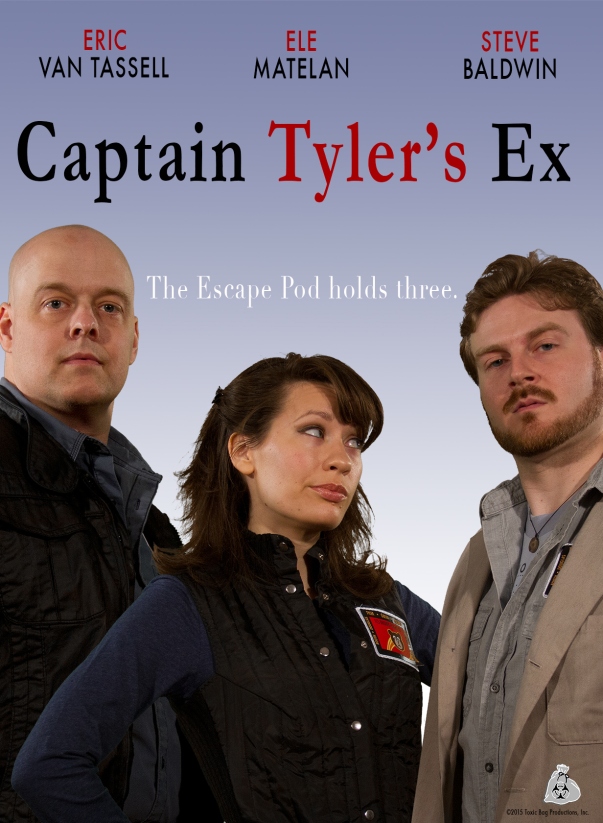
Workplace romances can be challenging. But when your workplace has been invaded by a violent and predatory creature from a genetics lab, it’s downright impossible.
In “Captain Tyler’s Ex,” the new romantic comedy from Toxic Bag Productions, Science Officer Franklin (Eric Van Tassell) and Navigator Whitaker (Ele Matelan) try to keep their relationship on track while being hunted down by the mysterious Specimen. The fact that one of them used to date Captain Tyler (Steve Baldwin) just makes matters worse. Also starring Alan Vuchichevich and Carly Joy as Engineers Booth and Douglas, a working couple with challenges of their own. Co-starring Leena Kurishingal (Gibson), Eric Neal (Palance).
Written and directed by Steve Baldwin and set in the world of Specimen, “Captain Tyler’s Ex” will begin filming in August 2015, with a direct-to-DVD release planned for Valentine’s Day 2016.
Deathscribe review
Toxic Bag’s own Steve Baldwin was one of five writers whose short plays were selected for inclusion in Wildclaw Theatre’s “Deathscribe” festival earlier this month. The horror blog Terror From Beyond The Daves has posted this cool review of the event.
End of the year Lists!
As 2014 draws to a close, you’re no doubt inundated with “Best of” and “Worst of” lists all over the place. Try as we might, we couldn’t resist the urge to try a couple of those ourselves to see what the fuss is about. So, we sat down with our good friends Eric Van Tassell and Ele Matelan (both of Specimen fame, among other things) to list our top genre movies and television shows of the year. We had a couple of great in-depth chats and the results are here in our two bonus year-end podcasts!
Best Genre TV shows of 2014 Podcast
Best Genre movies of 2014 Podcast
And of course, everyone’s got an opinion, so let us know yours! Send us a note at podcast@toxicbag.com or drop a note on our Facebook page!

New: Podcast Contest

We’re excited to announce the first ever Toxic Bag Podcast Contest! For the next three
months we’ll be giving away free soundpacks as well as a chance to win the Grand Prize.
Here’s how it works:
We’ll ask a trivia question in each podcast for the next three months. All you have to do is send us an email with the correct answer. All the correct entries will be put into a drawing and 10 random winners receive a free soundpack from our audio library.
The winners will also be entered into the Grand Prize Drawing to be held in December.
Send all entries to: podcast@toxicbag.com
Monthly Prizes: 10 Winners – A soundpack of your choice
Grand Prize: 1 Winner – A Specimen Print and Play, Zombie bundle and a Complete Collection – A $45 Value!
Click here to get the podcasts!
No purchase necessary. Void where prohibited. Only one monthly prize per contestant. Winners determined by random drawing from correct response emails sent to podcast@toxicbag.com. No cash substitutions. Employees of Toxic Bag Productions and DeLeo-Kaga Corporation, their families and business associates are not eligible. Contest ends December 31, 2014.
New sound: Steampunk Dirigible
You stand at the floor-to-ceiling windows at the back of the gondola and watch the city fade into the distance. In a mere 50 hours, you’ll be at your destination. Behind you, the steady hum of the airship’s propellers becomes a soothing drone, and only occasional gusts of wind remind you that you’re thousands of feet in the air. This is the only civilized way to travel, you think to yourself.
The Dirigible track is a 10-minute ambience that loops seamlessly, and features a constant sound of multiple propellers and occasional blasts of wind. This is a perfect background sound for airship travel in Steampunk, early 20th-century Cthulhu games and…is there a “Fringe” RPG?
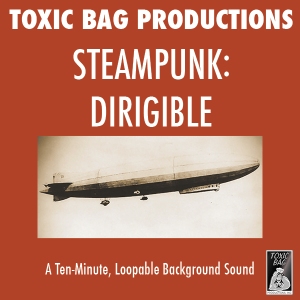
Our first sound effects CD, released in 1996, was The Game Masters Collection: Vol. 1: The Twentieth Century. Aimed at modern and modern-ish RPGs like Call of Cthulhu, it featured a variety of background ambiences including towns, cities, bars and nightclubs in several decades, a couple of battlefields…and a dirigible. The dirigible soon became a customer favorite – we almost got more compliments on that track than the whole rest of the disc.
Recently we were asked to create a longer, loopable version of the dirigible track for a LARP event, so we dug out the original track, remixed and remastered it, and have now released it as a ten-minute loopable mp3. You can pick it up for $1.50 at toxicbag.com, DrivethruRPG.com or D20pfsrd.com.
New sounds: Demon Flame!

Our new sounds for this month are tied in with a common horror trope: trapping the demon in a circle of enchanted flame. The binding ceremony usually involves drawing symbols on the floor in blood or salt, and setting the circle on fire once the demon steps inside.
Our Demon Fire soundpack comes in three varieties; the differentiating factor is the ignition source for the flame. ‘Cause, let’s face it – you don’t want your players asking, “hey, if we’re in a medieval setting, why am I using a Zippo to light this fire?” Or alternately, in a modern game, “where the heck did I get a torch?”
So, we’ve given you a torch, a match, and a lighter. Each ignition sound is followed by ten minutes of enchanted flame.
And in addition, each download comes with a ten-minute loop of magic flame with no ignition sound, so if you just want continuous fire, you can do that too at no extra charge!
Of course, these fire sounds don’t have to be used exclusively to depict demon traps. Really, you could use them for just about anything your players feel like setting on fire. And if your players are like ours, that’s a lot of things!
Torch (Fantasy/Medieval demon hunter)
The daemon has walked right into your carefully-laid trap; directly into the center of the circle of blood sigils on the stone floor. In the dim light of this dank dungeon, it was easy to conceal it with some hastily-arranged dirt and pieces of rat dung. You touch your torch to the edge of the circle, and the floor erupts in a magical flame.
Now, daemon, we will talk.
This effect is the sound of a torch igniting a magic flame that burns for ten minutes.
Match (Steampunk/Early 20th Century demon hunter)
You have the demon right where you want it. It’s just walked right into the center of the circle of blood sigils you painted on the floor. Before it knows what’s happening, you light a stick match and touch it to the blood. The circle erupts in a magical flame that spreads out to both sides and surrounds the demon in a second.
Shall we begin our conversation, hellspawn?
This effect is the sound of a wooden stick match igniting a magic flame that burns for ten minutes.
You’ve got the demon right where you want him. The smug sonofabitch just walked right into the center of the circle of blood sigils you hid under the throw rug. You smile, just a little, and spark up the chrome lighter in your hand. You throw it to the floor, and the circle erupts in a magical flame. Now old blackeyes there is trapped until you say so.
Before I gank you, you’re gonna spill, buttwipe.
This effect is the sound of a modern lighter igniting a magic flame that burns for ten minutes.
Demon Flame Loop
Now that the demon is trapped within the blood circle, the flame will continue to burn and he won’t be able to leave. This ten-minute loop of magic demon fire will allow you to question him all you like.
Each of the Demon Flame soundpacks are available for $1.25 from toxicbag.com and $1.50 from DrivethruRPG.com.
Specimen Print on Demand Cards!

The captain and his card.
We’re tremendously excited to announce that we’ve set up all 122 cards for the game as a Print-on-Demand product, available from DriveThruRPG.com. Now instead of printing out, cutting out and pasting together all those cards, you can have a professionally printed deck delivered straight to your mailbox (You will still need to print out and assemble the map, counters and screen, but this does save you an awful lot of work).
The Print-on-Demand decks cost $9.99 + shipping. The Specimen print and play download costs $9.99 from Drivethru and $9.00 from Toxicbag.com.

25 attribute cards

7 Character cards

45 Crew strategy cards

45 Monster strategy cards

Print-on-Demand card set from DriveThruRPG
Science Fiction toolkit
You’ve crafted your universe and created the PCs. Everything is in place to begin your epic RPG Campaign for galactic domination. All that’s left is to add that final element: sound. Toxic Bag’s Science Fiction Toolkit gives you the audio building blocks to help create worlds that, before now, the players had only imagined. Designed for use with any RPG system, the toolkit will help make your sci-fi games better.
Over 45 minutes of Sci-Fi Sounds!
Tracks Include:
Sci-Fi Battle *
Jump to Lightspeed ¥
Time Machine Interior (10 minute ambience) ¥
Self-Destruct Sequence ¥
Cyberspace (10 minute ambience) ¥
Starship Bridge (10 minute ambience) †
Star Cruiser Rumble (10 minute ambience) †
Red Alert (6 minute effect) †
GM Soundpack: Blasters & Deflector Shields (click for description)
* Previously available on the Battles Collection
¥ Previously available on the Strange Places Collection – remastered for this set
† New Sound
The Science Fiction Toolkit is available from toxicbag.com and DrivethruRPG.com.

 Toxic Bag Productions